The Supreme Court declined Boeing’s appeal in a pilot union fraud case. The claims survive, the merits remain untested, and the story underneath is about a single commercial proposition and what happened when it collapsed.
On February 23, 2026, the U.S. Supreme Court denied Boeing’s petition for certiorari in The Boeing Company v. Southwest Airlines Pilots Association.1 The order made final a 7-2 ruling from the Texas Supreme Court that SWAPA’s fraud and misrepresentation claims against Boeing can proceed to trial.2
The consensus reading is that Boeing lied to pilots about the MAX, and a court says they can sue. The reality is more specific and more interesting. A manufacturer built an entire aircraft programme around a single proposition, “same plane, no retraining”, then hid the engineering required to make that proposition hold. When two crashes and 346 deaths exposed the gap, every representation Boeing had made about the MAX became a potential liability to crash victims and to anyone Boeing had told “it’s the same plane.” SWAPA is one of those anyones, and this claim may be the most structurally dangerous Boeing faces.
I. The Proposition
The 737 MAX existed to be the 737 NG, and that was the commercial case. Airlines operating the NG could add the MAX without retraining their fleets with simulator time or new type ratings, because pilots only needed a short ground course on the differences. Every airline that bought the MAX was buying that proposition, and Southwest bought 150.
The FAA granted the MAX a common type rating with the NG, which made the proposition a regulatory fact.3 But the FAA did not arrive at that fact independently. Boeing pursued the common type rating as a design objective from the programme’s inception. The MAX’s larger, more forward-mounted engines changed the aircraft’s pitch characteristics.4 Left unaddressed, those changes would have broken the common type rating, and the aircraft would not have handled enough like the NG to qualify. So, Boeing implemented the Maneuvering Characteristics Augmentation System (MCAS), which existed to preserve the proposition.
Then Boeing removed MCAS from pilot manuals, an omission The FAA approved. The aircraft that airlines were told required no additional training contained a flight-control system that pilots were not told existed.
This is the sequence that matters, because every “no additional training” representation Boeing made to anyone rested on an engineered certification and an undisclosed system, and when MCAS failed and two aircraft crashed, the representations became tragic and contestable.
II. The Contract Fight
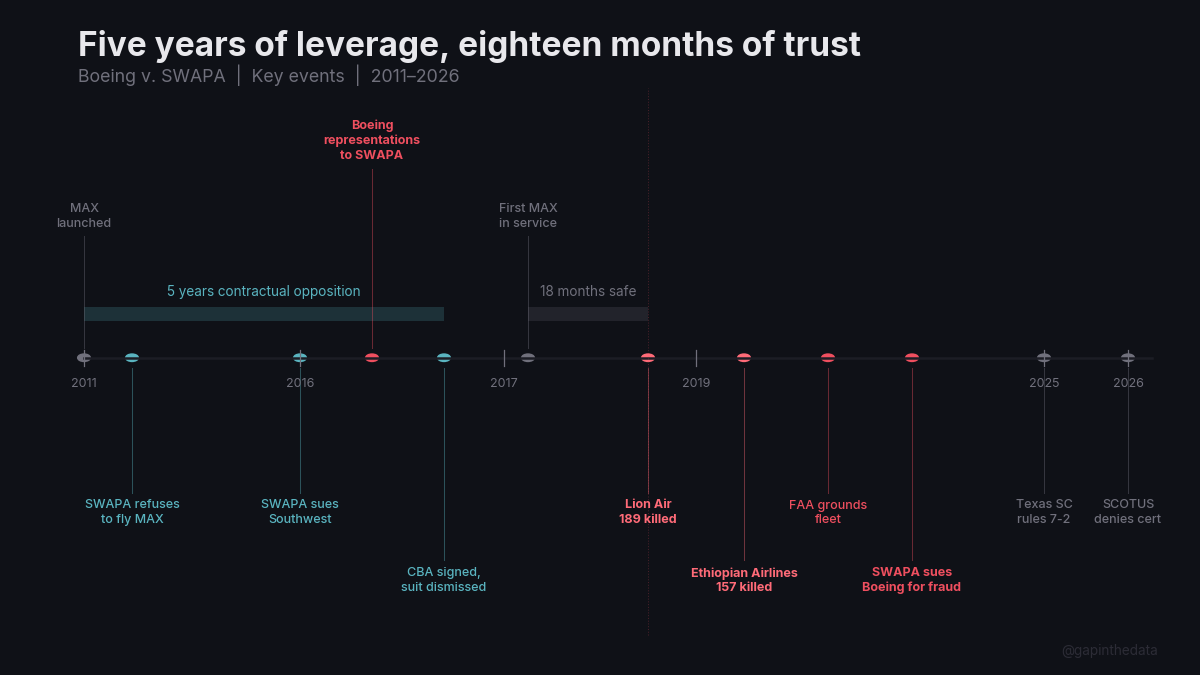
Boeing told SWAPA’s negotiating team the MAX was “essentially a more fuel efficient” version of the NG and that pilots could fly it without additional training.5 That representation is the basis of their fraud claim, but read the timeline around it.
Boeing launched the MAX in 2011, and SWAPA took the position that Southwest’s existing collective bargaining agreement did not require its pilots to fly the MAX, refusing to do so.6 SWAPA’s objection was over fleet scope and compensation rather than safety, aimed at gaining bargaining leverage. SWAPA picketed airports7, and in 2016, SWAPA sued Southwest in federal court, arguing the status quo did not require MAX service.8
During the settlement negotiations that followed, Boeing allegedly intervened with its representations about the MAX. SWAPA agreed to the 2016 CBA, which required its pilots to fly the aircraft, dismissing the federal suit.9 Southwest put its first MAX into service in August 2017.
After eighteen months of safe operation, the Lion Air crash occurred in October 2018, followed by Ethiopian Airlines in March 2019. The FAA grounded the fleet and SWAPA sued Boeing for fraud.10
A union that had opposed the MAX for five years on contractual grounds reframed its position as safety fraud after the crashes. Boeing will argue the reframing is the whole story, that SWAPA fought the MAX over money, accepted it for money, and discovered a fraud claim only after external events made the MAX politically untenable.
Boeing’s argument is incomplete for the same reason SWAPA’s narrative is, because SWAPA’s pre-crash opposition doesn’t erase Boeing’s concealment of MCAS, and Boeing’s concealment of MCAS doesn’t erase SWAPA’s pre-crash opposition. Both sides are telling the half that helps them, and the full timeline helps neither.
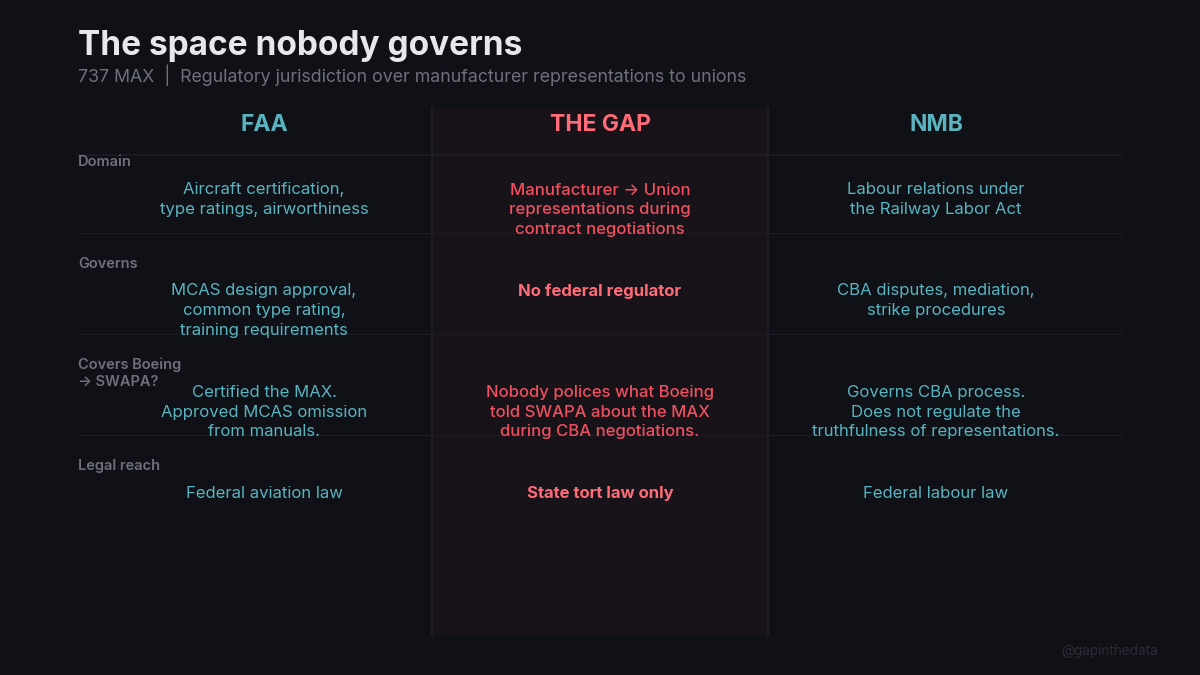
What makes this case different from the other MAX litigation is that Boeing’s representations to SWAPA occurred in a space no regulator covers. The FAA certifies aircraft and the National Mediation Board governs labour relations under the Railway Labor Act, but neither polices what a manufacturer tells a union about an aircraft during contract negotiations. Boeing walked into that unregulated space and made statements that were literally true as certified and materially incomplete as communicated. Only state tort law reaches that conduct.
III. What the Court Decided
The Texas Supreme Court resolved two procedural questions, neither of which touched the merits.
Boeing argued the Railway Labor Act preempts SWAPA’s state-law claims, and the court disagreed: whether Boeing lied about the MAX is a factual question that does not require interpreting any CBA.11 Boeing argued that 8,794 individual claim assignments to SWAPA circumvent restrictions on associational standing, and the court disagreed again: the Legislature has not prohibited assignment of claims to an association, and one form of standing does not circumvent another.12^,^13
The court did impose one constraint that may determine whether the case survives the merits. To recover on any pilot’s claim, SWAPA must prove that the specific pilot relied on Boeing’s representations and suffered a particular amount of damages.14 Boeing’s representations were made to a negotiating team rather than to 8,794 individual pilots, and whether a line pilot in Phoenix who never heard Boeing’s statements can be said to have “relied” on them is the unresolved question that will decide whether this case is viable or collapses under its own structure.
The dissent warned that the majority’s assignment holding allows associations to become “clearinghouses for mass torts” without adequacy-of-representation requirements or opt-out rights.15 The Supreme Court’s cert denial changes nothing about that posture,16 and the Texas Supreme Court’s own framing remains: “We need not and do not decide here whether SWAPA’s contentions are true."17
IV. The Vehicle
SWAPA holds 8,794 assigned claims, each from a pilot who waived the right to sue Boeing individually.18 Any recovery routes through SWAPA and is distributed proportionally to W-2 earnings, less “fees, expenses and financing costs” that are not disclosed in the court record.19 No class-action protections apply, no adequacy-of-representation finding is required, and no opt-out mechanism exists.
SWAPA’s own estimates place damages “in excess of $100 million,"^20^ representing incremental lost flight hours, overtime, and premium pay during the grounding. For a company with $89.5 billion in revenue, the exposure is in the documents Boeing must produce, not the damages.
To defend on the merits, Boeing must produce internal records on MCAS design decisions, training representation approvals, marketing materials presented to unions, and communications about the common type rating strategy. Those documents do not stay in this case, because Boeing also faces a Department of Justice deferred prosecution agreement, shareholder derivative suits, wrongful death litigation from crash victims’ families, and ongoing FAA oversight, and civil discovery in a union compensation case feeds document production across all of them.
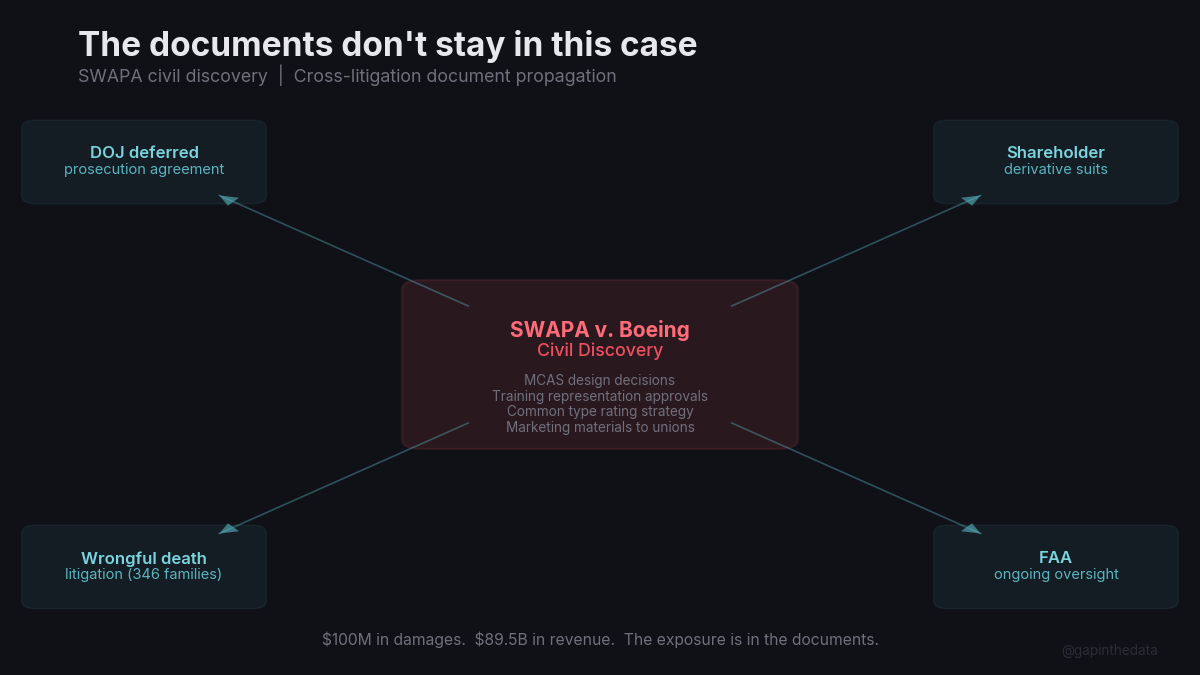
Both sides have reasons to settle before that happens. Boeing wants to contain the documents, and SWAPA wants to avoid proving individual reliance for 8,794 pilots, which is the constraint the court imposed and the one most likely to kill the case on the merits. Whether those documents have already surfaced in parallel proceedings determines how much containment a settlement actually buys.
The coverage will focus on whether Boeing lied, a question the court declined. What it produced is a vehicle pointed at what Boeing’s internal documents say about a proposition that killed 346 people, and where those documents travel once they surface.
No regulator governs what you tell pilot unions about “same plane, no retraining,” and seven years after the first crash, that is still the open question.
Footnotes
1 Supreme Court of the United States, Orders List (607 U.S.), February 23, 2026. Under “Certiorari Denied”: “25-495 THE BOEING CO. V. SOUTHWEST AIRLINE PILOTS ASSN.” Source: https://www.supremecourt.gov/orders/courtorders/022326zor_7758.pdf
2 Supreme Court of Texas, No. 22-0631, The Boeing Company v. Southwest Airlines Pilots Association, June 20, 2025. Justice Boyd delivered the opinion of the Court (7-2). Source: https://www.txcourts.gov/media/1460738/220631.pdf
3 Texas Supreme Court opinion at 4: The FAA granted the MAX a common type rating with the 737 NG, permitting pilots certified on the NG to fly the MAX with differences training only.
4 Texas Supreme Court opinion at 1, fn. 2: “Boeing implemented the Maneuvering Characteristics Augmentation System (MCAS) to account for the 737 MAX’s larger engine, which sits more forward on the wing than in earlier 737 variants.” Citing Dominic Gates, Flawed analysis, failed oversight: How Boeing, FAA certified the suspect 737 MAX flight control system, Seattle Times (Mar. 17, 2019).
5 Texas Supreme Court opinion at 4: “SWAPA alleges that Boeing inserted itself into SWAPA’s settlement negotiations with Southwest and falsely assured SWAPA that the MAX was ’essentially a more fuel efficient’ version of the 737 variant they were then flying and that pilots could fly the MAX without additional training.”
6 Texas Supreme Court opinion at 3: “After Boeing introduced the MAX in 2011, Southwest purchased 150 of the planes, apparently believing the 2006 CBA’s list was broad enough to include the new MAX. SWAPA disagreed, and its pilots refused to fly the new planes.”
7 Mary Schlangenstein, Southwest pilots sue carrier to block flying of Boeing’s Max, Chi. Tribune (June 12, 2018), cited in Texas Supreme Court opinion at 4, fn. 5 (noting pilots “picketing at airports”).
8 Plaintiffs’ First Amended Complaint for Damages & Jury Demand, Sw. Airlines Pilots Ass’n v. Sw. Airlines Co., No. 3:16-cv-01346-O (N.D. Tex. May 19, 2016), ECF No. 6. Cited in Texas Supreme Court opinion at 4, fn. 6.
9 Joint Stipulation of Dismissal, Sw. Airlines Pilots Ass’n v. Sw. Airlines Co., No. 3:16-cv-01346-O (N.D. Tex. Nov. 11, 2016), ECF No. 29. Cited in Texas Supreme Court opinion at 5, fn. 7.
10 Texas Supreme Court opinion at 5: SWAPA “filed this suit against Boeing in state court, asserting state-law claims for fraudulent and negligent misrepresentation, tortious interference with SWAPA’s contractual rights and business relationship with Southwest, negligence, and fraud by non-disclosure.”
11 Texas Supreme Court opinion at 12, citing Hawaiian Airlines, Inc. v. Norris, 512 U.S. 246 (1994), and Lingle v. Norge Division of Magic Chef, Inc., 486 U.S. 399 (1988). See also opinion at 15: “even if the 2006 CBA required the pilots to fly the MAX, SWAPA had no obligation to agree to fly it in the 2016 CBA.”
12 Texas Supreme Court opinion at 6: “8,794 of SWAPA’s members executed documents assigning their claims against Boeing to SWAPA.”
13 Texas Supreme Court opinion at 23-24: “the Legislature . . . has not imposed the same prohibition against a member’s assignment of his claim to an association, although it certainly could have done so.” And: “Associational standing, class-action standing, and standing based on an assignment provide alternative means for obtaining standing.”
14 Texas Supreme Court opinion at 22-23: “To recover damages on a pilot’s claim for tortious interference or misrepresentations, for example, SWAPA must establish that each individual pilot relied on alleged misrepresentations and suffered a particular amount of damages as a result.”
15 Dissent of Justice Bland, joined by Justice Huddle, at 10: “nonprofit organizations are free to become clearinghouses for mass torts—with none of the protections that other mass-action vehicles afford.” Source: https://www.txcourts.gov/media/1460739/220631d.pdf
16 The Supreme Court rarely grants certiorari to review state supreme court interpretations of state law absent a federal constitutional issue. Boeing’s petition rested primarily on the RLA preemption question, which the Texas Supreme Court resolved by applying settled federal precedent without creating a conflict.
17 Texas Supreme Court opinion at 15: “We need not and do not decide here whether SWAPA’s contentions are true. We explicitly do not decide whether SWAPA can establish that Boeing made misrepresentations or that the alleged misrepresentations in fact induced SWAPA or the pilots to agree in the 2016 CBA to fly the MAX and thereby caused SWAPA and the pilots to incur financial losses.”
18 Assignment agreement, quoted in Texas Supreme Court opinion at 18, fn. 22: “I understand that in making this Assignment, I am waiving my right to individually pursue any and all claims, demands, and/or causes of action for My Damages that I have or may have against Boeing arising out of the MAX crisis.”
19 Assignment agreement, quoted in Texas Supreme Court opinion at 17-18, fn. 22. Damages distributed “in an equitable manner in proportion to gross W-2 earnings per pilot,” less each pilot’s “proportional share of all fees, expenses and financing costs associated with the Litigation.”
20 Dissent at 5, quoting SWAPA’s petition: “millions of dollars in lost compensation.” SWAPA’s own estimates referenced in briefing indicate damages “in excess of $100 million.”